See it running
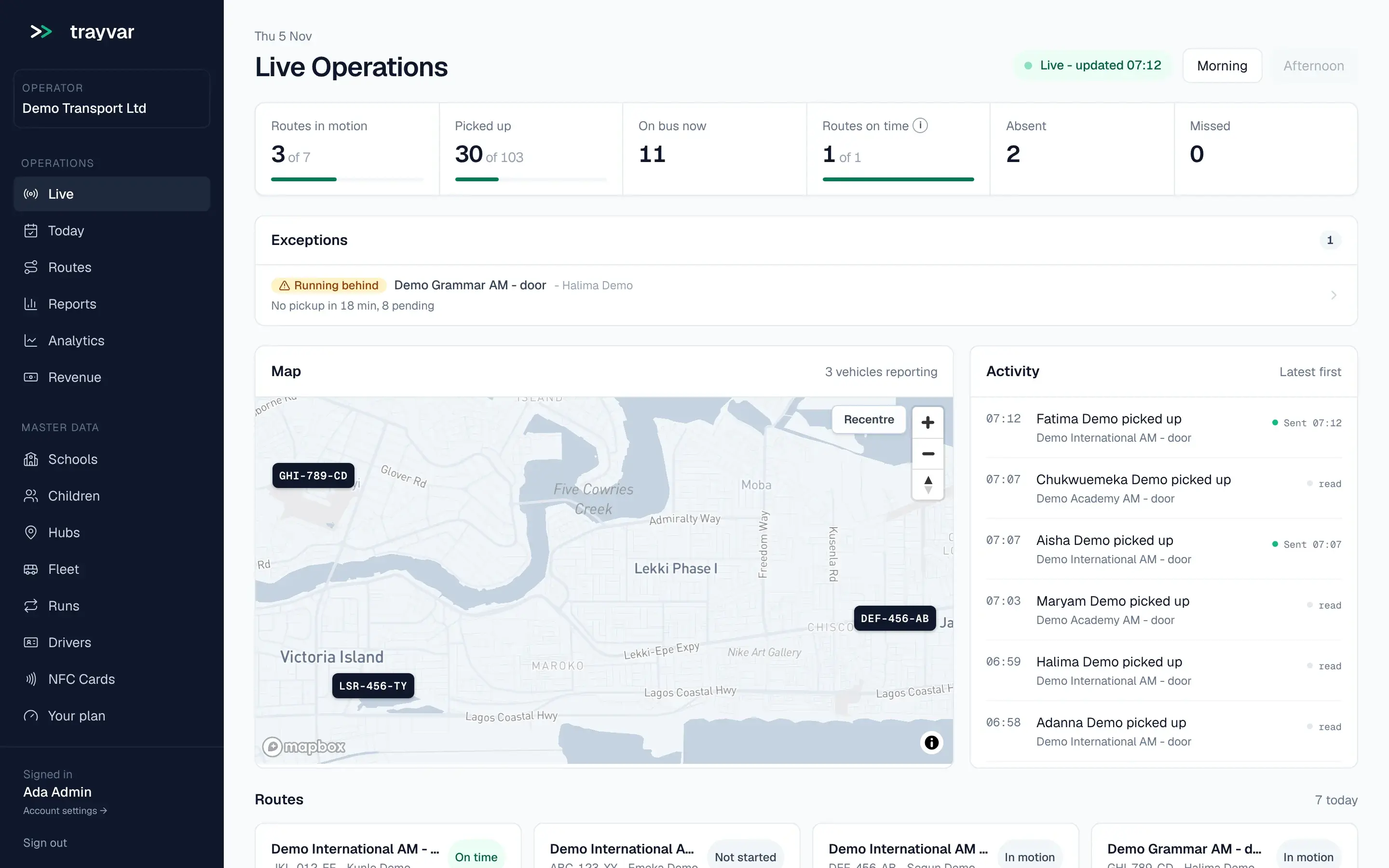
The whole school morning, on one screen.
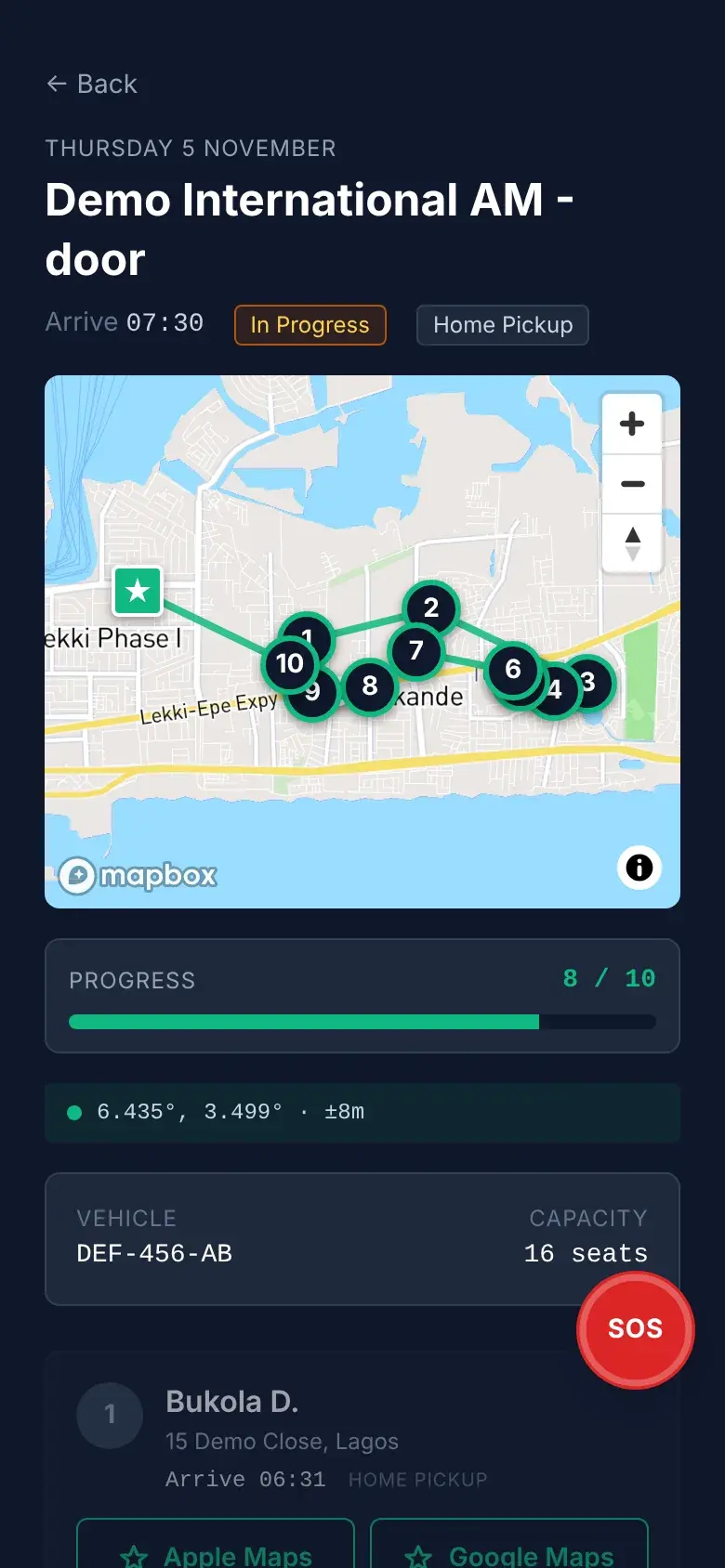
The operations team sees every route, every pickup and every exception as it happens, while the driver works from the app beside it. More on the school bus tracking app.
Why Trayvar exists
School transport in Africa runs on WhatsApp groups, spreadsheets and the operations manager's memory. That works at 30 children. It does not work at 300.
Trayvar is the layer that absorbs the complexity. The platform clusters children into pickup hubs, plans the routes (overnight and by itself on Growth and Scale), delivers them to drivers on Android phones built to work offline on 2G, records each pickup with an NFC card tap and GPS, keeps parents informed on WhatsApp and reports to operators and schools on every period. Built for the operating realities of West and East Africa, and for the people who run them.
What Trayvar does
Four functions, one platform, designed to work together.
Routing
The optimiser clusters children into hubs and sequences every route, overnight and by itself on Growth and Scale and route by route on Starter. Door pickup runs beside hubs on Growth and Scale. The operator reviews and approves in the morning.
NFC-enabled driver app
Android-first, offline-capable and built for 2G, on the phones drivers already carry. Children tap an NFC card to board; each pickup is GPS-verified; a panic button is built in.
Parent messages
WhatsApp is the channel parents already use. Trayvar sends pickup, approach and drop-off messages through it, to the parents who have agreed to receive them.
Live and reports
Every route on one screen while it runs, scored on time or late. Every period closes with an operations report, and a service report for each school.
Who Trayvar is for
Operators who run school buses, and the schools that run their own.
For operators
You run school buses as a business.
Plan the routes for each school you serve, watch every morning on one screen and hand each school its own service report, under your name.
How operators use TrayvarFor schools
Your school runs its own buses, or contracts an operator.
Run your own fleet on Trayvar directly, or receive your operator's reporting and the same WhatsApp updates for your parents.
How schools use TrayvarHow Trayvar fits your operation
Two pickup modes, built for how your market actually moves.
Hub mode
For shared pickup operations
Children gather at designated pickup points - bus stops, school gates, neighbourhood meeting spots. The driver visits each hub to collect children together. Suits operations where parents bring children to a common collection point. Common for schools with established neighbourhood transport patterns and operators serving suburbs with defined pickup zones.
Door mode
For home-to-school operations
Each child is picked up from their home address, on Growth and Scale. The driver visits each home in turn. Suits operations where parents expect collection at the front gate. Common for premium schools, smaller fleets serving fewer children per vehicle and markets where shared hubs aren't culturally accepted.
Hub and door pickup mix freely on Growth and Scale, so Trayvar supports operators who serve schools with different conventions, or who are moving from one model to the other. Every run uses hubs on Starter.
Built for the operating reality
Drivers on 2G phones. Pickup points the geocoder doesn't recognise. Bell times that vary by class.
Trayvar was designed in Lagos and engineered for the conditions West and East African school transport actually runs on. The NFC-enabled driver app holds its route offline. A pin on the map stands in when the address line fails. Afternoon runs split by class, so a Kindergarten that finishes at 12:30 and a Secondary that finishes at 15:30 go home on the same day, in the same vehicle.
This is what infrastructure looks like when it's built for the buyer who lives the operation - not retrofitted from a US fleet tool.
How it works
Twelve stages. Two perspectives. One operating day.
Account and fleet
Trayvar opens the account with you. Your team adds vehicles and drivers, and issues NFC cards.
Schools and children
Add schools, campuses and bell times. Import children from a spreadsheet, each with a home location and times by day.
Hubs and routes
The optimiser clusters home pickups into hubs and builds the routes for approval, overnight and by itself on Growth and Scale and route by route on Starter.
Live operations and reports
Drivers run the route. Parents get WhatsApp updates. Operators watch Live. Every period closes with a report.
Trayvar is a Carthena Advisory product. Built by the firm that has spent years advising African organisations on operating, financial and strategic questions - and decided to build software for one of them.
About Carthena AdvisoryTalk to us about your fleet.
If you run a school transport fleet anywhere in West or East Africa, we should talk. Pilots run for 14 weeks. The platform pays for itself within the first term.
Book a conversation